More leads alone do not repair a lead system that cannot respond, qualify, book or deliver reliably. Before increasing lead volume, check where work currently stops and whether the people responsible for the next step have enough capacity.
The decision is not simply “scale” or “do not scale.” Use three options:
- Pause when an important handoff is already failing.
- Prepare when the process works but added volume would overload it.
- Proceed when enquiries have a reliable place to go, named people handle the next steps and delivery can absorb the added work.
Start with the constraint, not the lead source
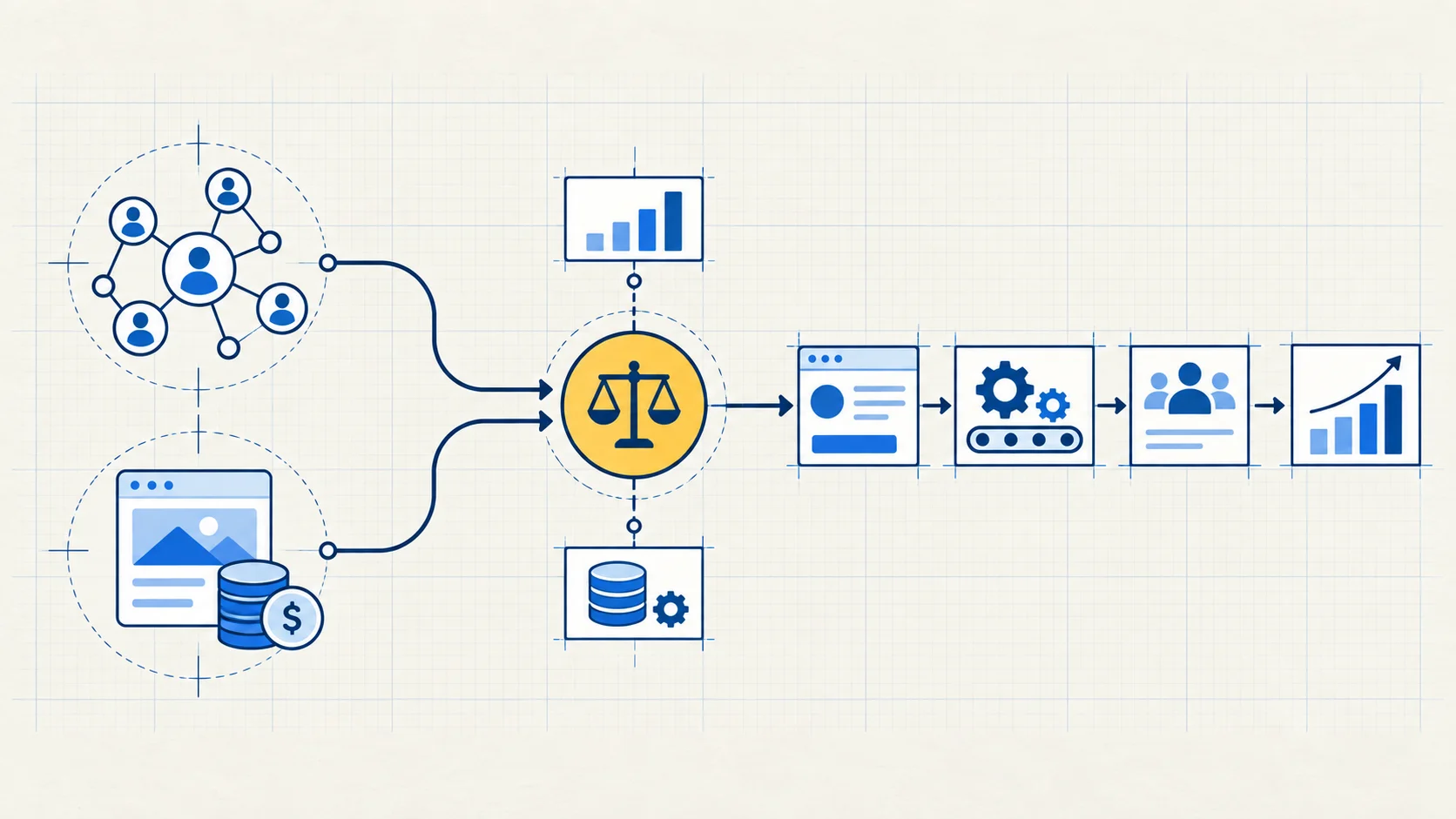
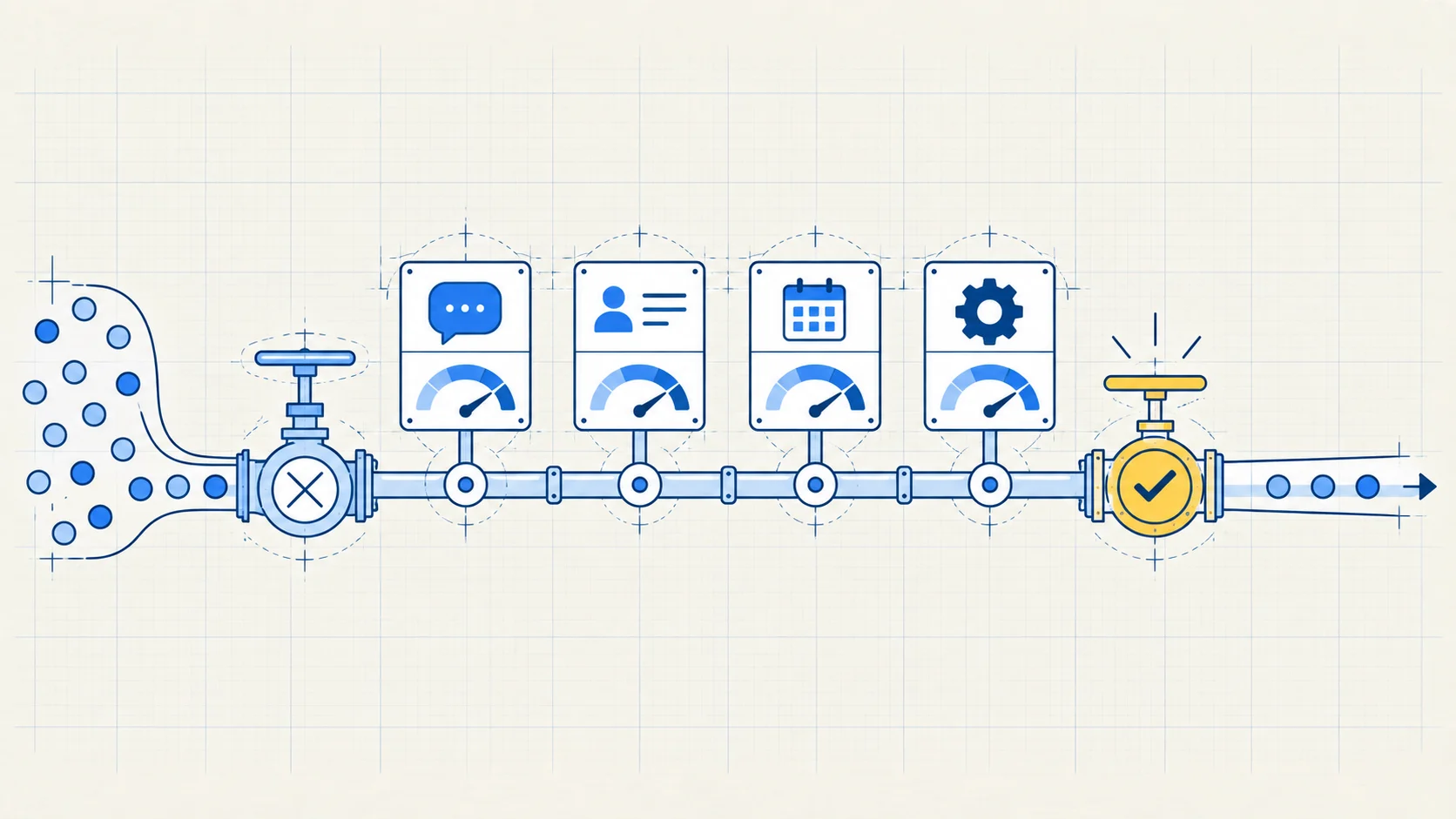
A useful lead path can define stages such as enquiry, notification, response, qualification, booking and delivery. Mapping those stages helps you locate the stopped handoff instead of relying on memory or improvised follow-up.
That changes the scaling decision. If your team receives enough enquiries but leaves them spread across inboxes, adding more enquiries increases the load on the same weak handoff. If enquiries are handled well but fulfilment is already stretched, the constraint sits after the sale. If the process has spare capacity but enquiries are scarce, increasing inputs may be a reasonable test—but first confirm that enquiries are being captured and measured correctly.
Do not call every problem a leaky bucket. A business with no enquiries has an empty pipeline; a business receiving enquiries and losing them at a handoff has a conversion or operating problem. Those situations require different action.
Walk through one recent enquiry
Choose a real enquiry and trace what happened:
- Where did it arrive?
- Who was notified?
- Who owned the response?
- Where was qualification recorded?
- How did the person book or take the next step?
- Who followed up if they did not continue?
- If they bought, who accepted the work and scheduled delivery?
You are looking for ambiguity, delay and manual copying—not trying to make every stage perfect. A single unclear owner or hidden inbox can matter more than another campaign.
Measure beyond the initial lead count. A full-chain view can include leads, qualified leads, scheduled calls, attendance, sales, collected cash and fulfilment cost. The purpose is to keep the downstream outcome connected to the activity or message that produced it, so your next change responds to the actual constraint.
Calculate the added workload
Use a simple, labelled hypothetical before you increase inputs.
Suppose you are considering an activity that might add 20 enquiries per week. This is planning arithmetic, not a forecast, result or benchmark.
Your assumptions are:
- 15 minutes to review and respond to each enquiry
- 8 of the 20 enquiries may need a 30-minute qualification call
- 3 may become customers
- each new customer may require 2 hours of setup during the first week
The possible additional weekly workload is:
- Initial response: 20 × 15 minutes = 5 hours
- Qualification: 8 × 30 minutes = 4 hours
- New-customer setup: 3 × 2 hours = 6 hours
- Total: 15 additional hours in the first week
That total excludes proposal revisions, rescheduling, internal coordination, ongoing delivery and exceptions. Replace every assumption with your own observed figures and add the work your process actually requires.
The calculation does not tell you whether the activity is commercially worthwhile. It reveals whether your proposed increase has an operational home. If nobody can identify where those 15 hours would come from, the business is not yet prepared for that hypothetical volume.
Use this pause, prepare or proceed check
| Area | Pause | Prepare | Proceed |
|---|---|---|---|
| Enquiry capture | Enquiries can be missed or exist in conflicting records | One record is being established, but exceptions remain | Each enquiry has a visible place and status |
| Ownership | Several people may respond, or nobody clearly owns it | A named owner exists but needs backup or instructions | A named owner and backup know what to do |
| Follow-up | Non-bookers disappear without a decision | Follow-up steps are being documented | Follow-up has a clear next step and respectful closure |
| Qualification | The team cannot explain what makes an enquiry suitable | Criteria exist but are applied inconsistently | Criteria guide routing and the next conversation |
| Fulfilment | Current work is late, unstable or dependent on heroics | Capacity or scheduling changes are underway | Added work can be assigned without displacing commitments |
| Measurement | Lead totals cannot be reconciled with later outcomes | Definitions and records are being aligned | The team can trace a cohort from source to downstream outcome |
Treat the table as a decision aid, not a universal benchmark. One “pause” in a critical stage can outweigh several “proceed” answers. For example, available delivery capacity does not compensate for enquiries that nobody owns.
What to do next
Pause if added volume would enter an unmanaged process or worsen an existing delivery problem. Fix the stopped transition first.
Prepare if demand can be handled only after a defined change. That might mean assigning an owner, establishing one record, documenting qualification, creating response templates or reserving delivery capacity. Name the change, the responsible person and the evidence that will show it is working.
Proceed if the lead path is visible, the extra work has an owner and your capacity assumptions are credible. Start with a controlled test, keep the source attached to downstream outcomes and review what happened before increasing inputs again.
Postponement is also a valid decision. Established operators can choose to retain referrals, use internal staff, hire outside implementation help, learn the process or delay the work; the right model depends partly on who can implement and maintain the system. More leads are useful only when the business can do something useful with them.
I have spent thousands of hours studying marketing; my aim is to turn that learning into practical steps you can use. If you want to build and operate your own lead system, you can learn the process. If you want help building a system you control, explore whether Scale Manual is a fit for the work.