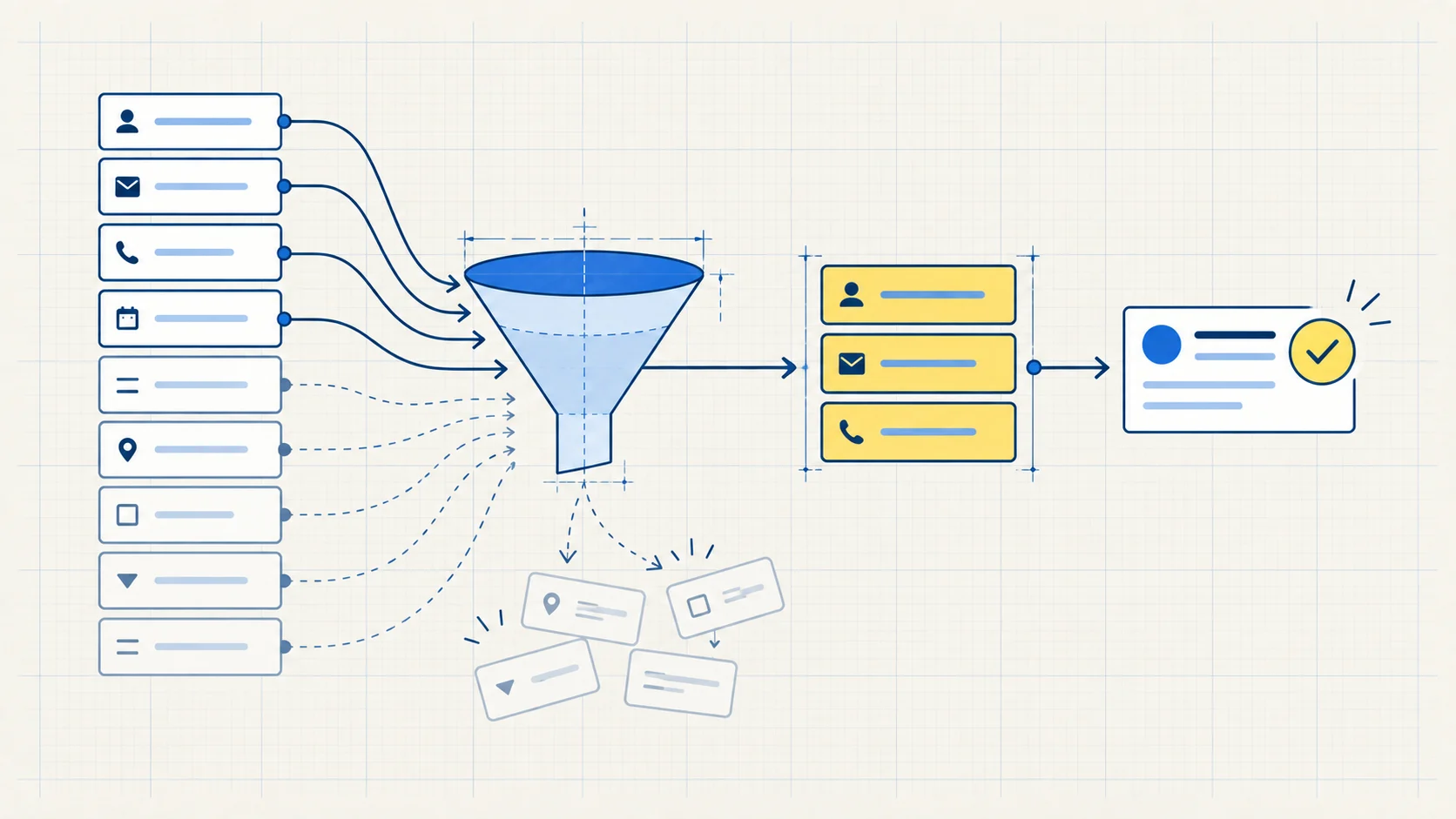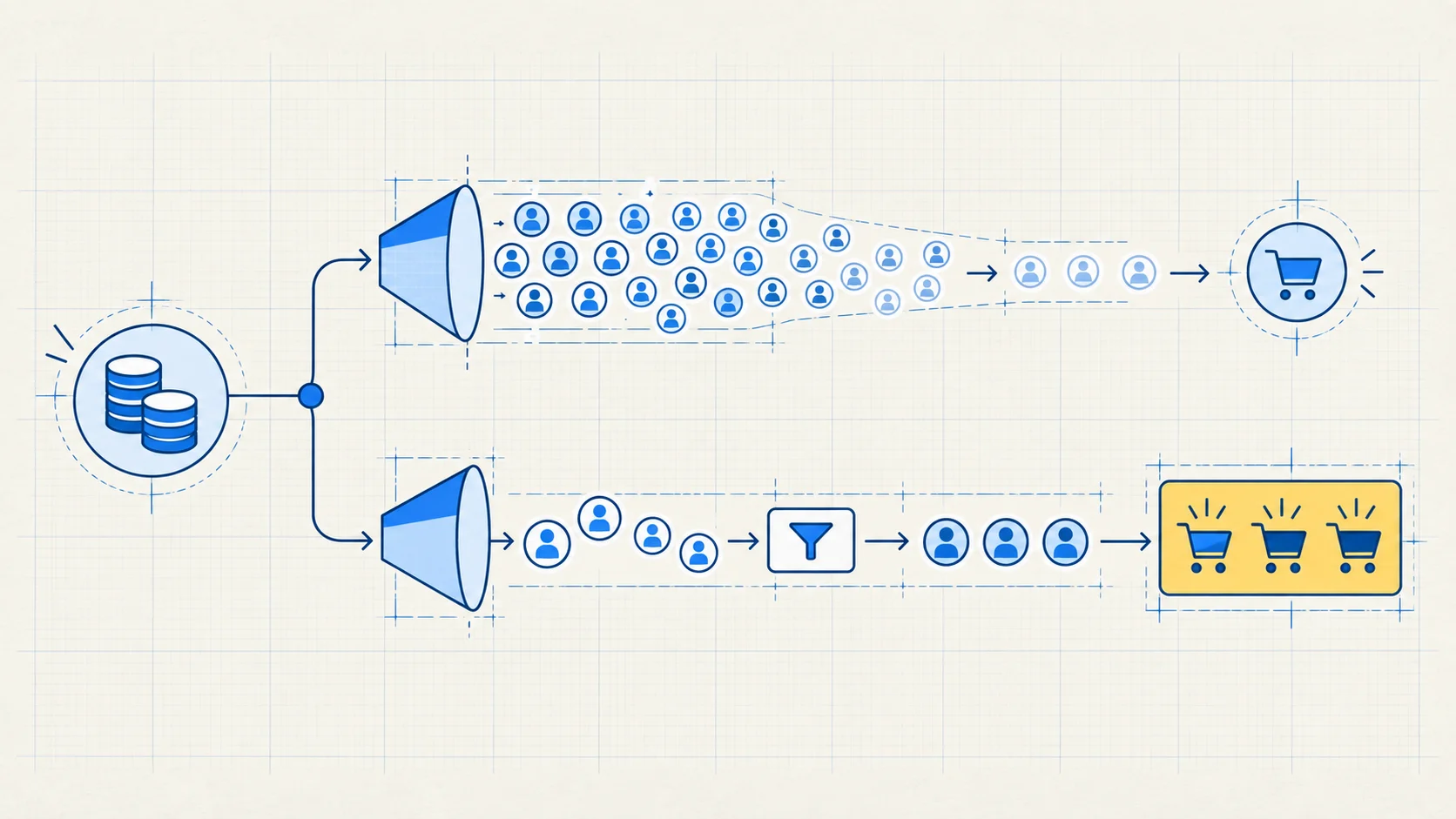

Before you write another ad, build a small record of the language surrounding real buying decisions.
Do not collect only compliments or memorable phrases. Compare what you heard from people who bought, declined, failed to attend and turned out to be a poor fit. Keep their actual words separate from your interpretation of what those words mean.
That distinction matters. A phrase can help you describe a recognisable situation, but it cannot prove someone’s means or establish that they are qualified. Your record should help you write a more precise invitation—not encourage you to make unsupported assumptions about the reader.
Collect decision evidence, not a folder of quotes
If your voice-of-customer file contains only positive quotations, it leaves out the contrasts that matter when deciding what an ad should say.
The more useful question is:
What language appears around different outcomes, and what might that tell us about the situation we should describe?
Scale Manual’s reviewed material recommends comparing won, lost, no-show and poor-fit enquiries while recording the customer’s situation and any qualification clue. This changes the task from searching for one persuasive phrase to looking for differences between groups.
For example, you might discover that several buyers described a broken follow-up process, while several poor-fit enquiries wanted an immediate result without assigning anyone to handle responses. That would be a pattern worth investigating. It would not prove that either phrase caused the outcome.
Repeated wording is a hypothesis to test, not causal proof.
Use a compact customer-language record
You do not need a large research database to begin. Create one row for each useful piece of evidence and preserve enough context to judge it later.
| Field | What to record | Why it matters |
|---|---|---|
| Exact words | The customer’s sentence as spoken or written | Prevents your summary from replacing their language |
| Outcome | Won, lost, no-show or poor fit | Makes comparison possible |
| Situation | What was happening in the business | Shows the operating context behind the words |
| Topic | Goal, problem, failed attempt, objection or constraint | Helps you group related evidence |
| Source | Call, email, form, message or interview | Lets you return to the original context |
| Segment | The relevant customer type or business situation | Stops unlike customers being treated as one group |
| Date | When the language was collected | Helps you notice when evidence may be stale |
| Permission | How the material may be used | Separates internal research from publishable quotation |
| Your interpretation | What you think the words suggest | Keeps inference visibly separate from evidence |
| Repeated independently? | Yes, no or not checked | Distinguishes one comment from an emerging pattern |
Preserving the exact sentence, source, segment, date and independent repetition makes the record easier to inspect instead of relying on memory.
Keep two columns that should never be merged
The most important design choice is the separation between what the customer said and what you think it means.
Suppose a customer says, “We get enquiries, but nobody knows who should reply.” Your interpretation might be that the business needs clearer lead ownership. That may be sensible, but it is still an interpretation. Another explanation could be missing notifications, inconsistent availability or a wider operating problem.
Write both down:
- Actual words: “We get enquiries, but nobody knows who should reply.”
- Interpretation: Possible ownership or handoff problem; verify before using it as a central message.
This makes it easier to spot when an internal diagnosis is being presented as if the customer had already accepted it.
Compare the four outcomes
Once you have several entries, review them by outcome rather than reading them as one long list.
Won
Look for the situation the buyer recognised, the consequence they wanted to address and the process they were prepared to join.
Lost
Record objections and competing priorities without assuming every loss reflects weak messaging. The customer may have had no urgency, chosen another route or decided not to act.
No-show
Look for possible gaps between the initial invitation and the next step. Treat these as questions, not conclusions: Was the next step clear? Did it ask for more commitment than the ad suggested? Was the person’s situation less urgent than it first appeared?
Poor fit
Record the mismatch precisely. Avoid vague labels such as “bad lead.” Was the requested service outside scope? Was there no owner for implementation? Did the person expect a different process?
Words can make a person’s operating situation, maturity and readiness more visible before a click, but they cannot establish qualification by themselves. Use the record to make the invitation clearer, then keep evaluating what happens after the enquiry.
A decision aid for your next ad brief
Before drafting, answer these five questions from your language record:
- Which operating situation appears in more than one independently collected entry?
- Does that situation appear more often around one outcome, or is the evidence mixed?
- Which exact words describe the situation without exaggerating it?
- What interpretation have you added, and what would you need to verify?
- Which one truthful signal of fit or readiness belongs in the invitation?
Then choose your next move:
| What you find | Next move |
|---|---|
| A repeated situation with clear context | Draft around that situation and test the message |
| Repeated words but mixed outcomes | Keep the wording, but do not treat it as a qualification signal |
| One striking comment | Save it as an observation; collect more evidence before centring the ad on it |
| Only your team’s summaries | Return to the original calls, messages or forms |
| No usable customer evidence | Begin a small set of customer interviews before writing another broad claim |
If no usable data exists, customer interviews are the appropriate starting point. The objective is not to delay every ad until the evidence is perfect. It is to know when you are using customer language, when you are using your own judgement and when you are testing a hypothesis.
Put the record before the copy
Your next ad does not need every phrase in the file. It needs a clear, truthful description of a situation that the right reader can recognise.
Collecting language across outcomes helps you avoid two errors: relying only on positive customer comments and mistaking your interpretation for the customer’s words. The resulting record becomes a maintained business asset that can inform later messaging decisions without pretending to prove what caused a sale.
I have spent thousands of hours studying marketing; my aim is to turn that learning into practical steps you can use. If you want to build and operate your own lead system, start with the record above. If you would rather explore help building a system you control, a fit conversation can establish whether practical guidance or implementation support makes more sense for your situation.