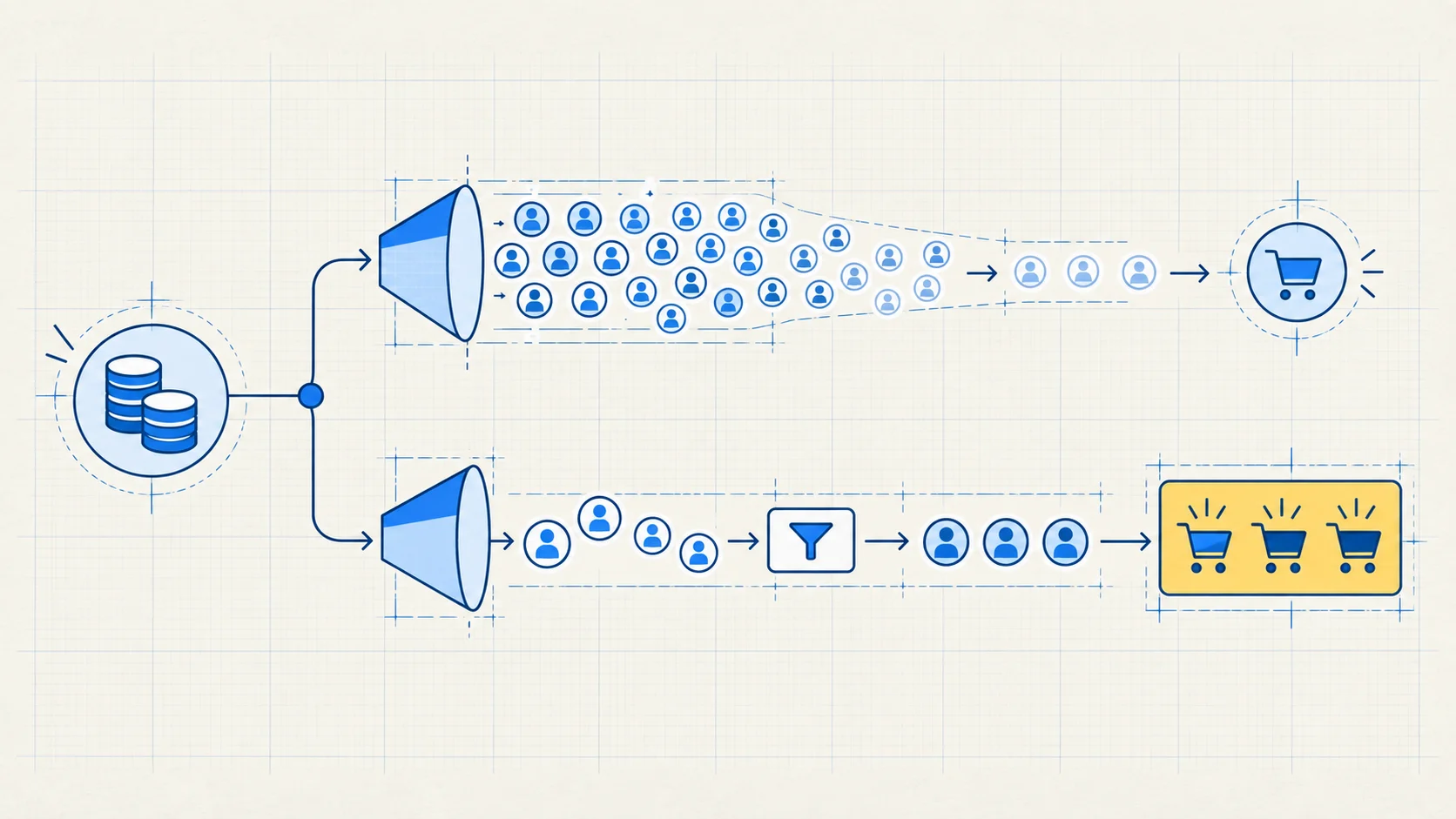

If your ads attract poor-fit enquiries, do not assume the form needs more questions. Start one step earlier: inspect whom the ad invites to respond.
An ad cannot prove that someone is qualified or able to buy. It can, however, describe a recognisable operating situation and ask for a level of participation that helps the right reader recognise themselves before clicking.
That distinction matters. The aim is not to make unsupported judgements about a person’s wealth or seriousness. It is to make your offer’s context, expectations and next step clear enough for readers to make a better initial choice.
What your message can—and cannot—do
Qualification has more than one dimension. A useful review considers fit, means, need, timing and readiness. Do not expect one ad to establish all five. Choose the few signals it can address truthfully:
- Fit: Is this offer designed for the reader’s type of business or problem?
- Need: Is the problem named clearly enough for them to recognise it?
- Timing: Is there a reason they want to address it now?
- Readiness: Are they willing to take the next step the work requires?
- Means: Can they support the engagement? Avoid treating job title, team size or other stereotypes as proof of this.
A reasonable hypothesis is that a broader invitation will leave more sorting to later stages, while an overly narrow one may exclude suitable buyers. Treat that as a question to test against downstream fit, not an assumed result.
The practical goal is not maximum restriction. It is enough specificity to help the intended buyer opt in—and everyone else understand why the offer may not fit.
A hypothetical rewrite
Suppose an ad begins:
Want more leads for your business? We can help you grow with a proven marketing system. Get started today.
This opening names a broad desire, but almost any owner could respond. It does not reveal the operating situation, the immediate problem or what participation will be expected.
A more selective hypothetical version might read:
Your service business has capacity for more work, but referrals arrive unpredictably and enquiries are not consistently followed up. Build a clearer lead and follow-up system around what you already know about your customers. You provide the customer knowledge and decisions; the implementation can be structured with you.
The rewrite does not declare the reader qualified. It makes three useful signals visible:
- Current situation: the business relies heavily on referrals.
- Need and timing: available capacity and inconsistent follow-up make the problem worth addressing now.
- Participation: the owner must contribute customer knowledge and decisions.
That participation signal is important. In Scale Manual’s working model, the owner supplies customer knowledge, judgement and direction, while implementation help can supply research, structure, execution and documentation. Stating the owner’s role in the invitation helps distinguish someone seeking a collaborative system from someone expecting a supplier to invent the business context for them.
The rewrite is only an example, not a ready-made ad. Replace its assumptions with conditions that are genuinely necessary for your offer.
Decision aid: audit the invitation before adding form fields
Use this short review on one current ad:
| Check | Question to ask | Keep or change the message when… |
|---|---|---|
| Reader | Does the opening identify a real role, stage or operating situation? | Change it if nearly any business could reasonably say “that’s me.” |
| Problem | Does it name the present difficulty rather than a vague ambition? | Change it if the message only promises “growth,” “more leads” or “better results.” |
| Readiness | What must the buyer already have, decide or contribute? | Add one truthful participation signal if the work depends on active owner input. |
| Promise | Does the promise match what the next page and conversation can support? | Narrow it if the ad implies an outcome the process cannot establish. |
| Exclusion | Are you screening for a genuine requirement or relying on a stereotype? | Remove signals that merely guess at wealth, intent or competence. |
| Next step | Will the action help you assess fit or move the conversation forward? | Simplify it if it creates effort without changing the next decision. |
Review the whole path after the message. Expectations should remain consistent across the ad, landing page and booking step. Compare the ad with the destination page: does the page preserve the same situation, promise and next step?
Test the commercial idea, not several changes at once
When you have a revised invitation, give the test one clear question. For example:
Does naming inconsistent referrals, available capacity and required owner participation produce enquiries that better match the offer?
Keep the offer and destination stable while changing the commercial idea in the message. Then assess a downstream outcome such as enquiry fit or progression to the next appropriate conversation—not attention alone. This is a practical comparison, not a statistically controlled experiment, and engagement by itself does not establish leads or sales.
Record what changed, what stayed stable, what happened after the click and what you will do next. If fit improves, keep investigating that message. If it does not, revisit the situation you named before adding more friction to the form.
When the form really is the problem
Start with the invitation, but do not force every qualification task into the ad. A form question is useful when the answer changes fit, routing or the next conversation. Operational details, service requirements or necessary constraints may be easier to handle there.
The sequence is the point:
- Make the intended situation and participation clear in the ad.
- Preserve that promise on the destination page.
- Ask only the questions needed for a useful next decision.
- Review downstream fit rather than judging the ad by cheap responses or engagement alone.
Make the buying situation visible early, then preserve that clarity through the rest of the system.
I have spent thousands of hours studying marketing, and my aim is to turn that learning into practical steps you can use. You can learn to build and operate your own lead system or explore help building a system you control. Run the audit above on a current ad and record the situation, participation signal and downstream measure you want to test.
If you want help applying this to your business, let's talk about what you need and whether we're a good fit.