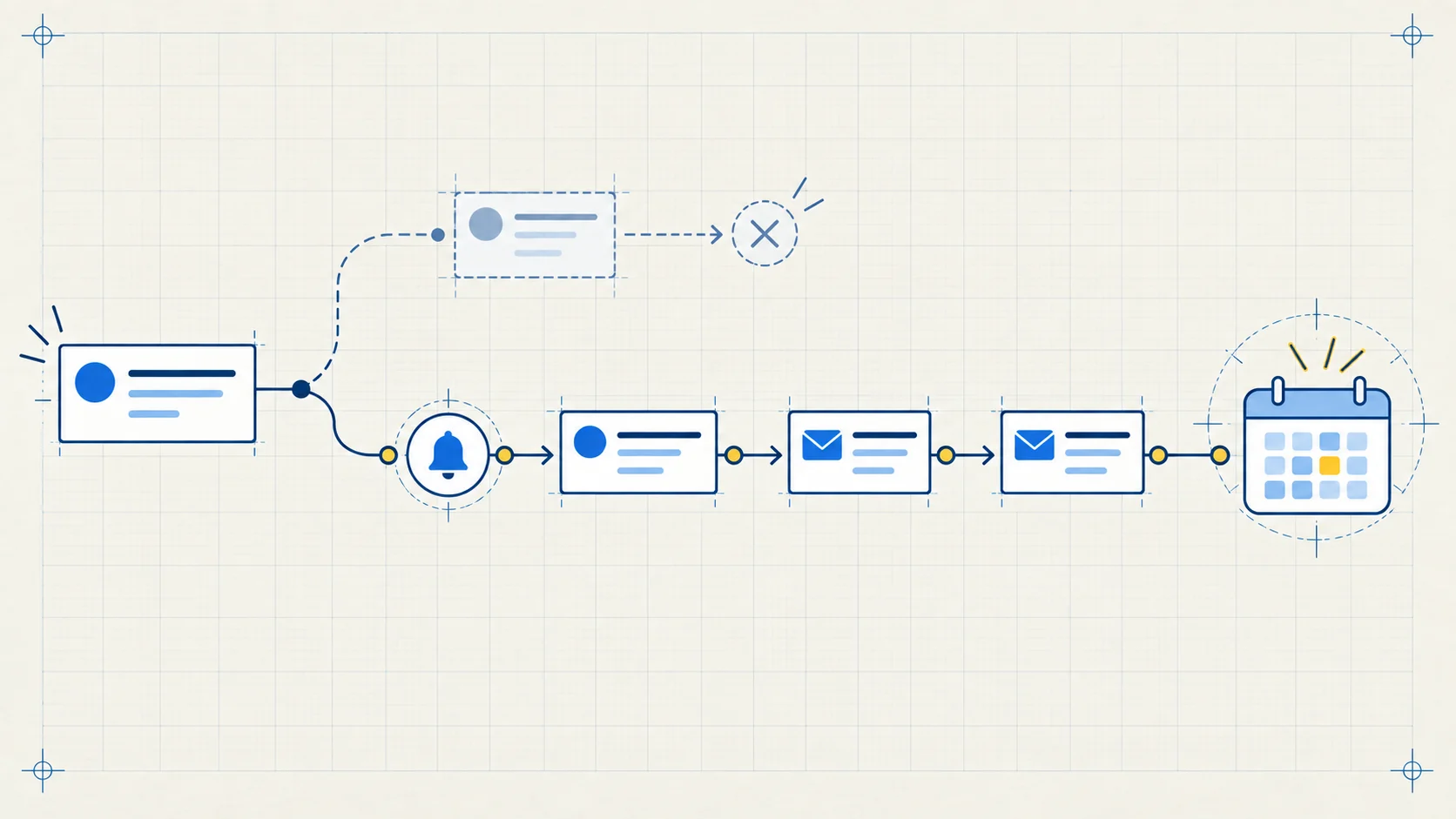
An enquiry that does not become a booking should enter a clear follow-up path. That path needs a visible status, a named owner, a useful response, a defined next step and a respectful way to close the conversation.
Do not begin by assuming you need more leads. First find the handoff where the current enquiry stopped. A visible lead path makes that diagnosis possible: map the stages so progress does not depend on memory or improvised follow-up, then improve the limiting transition rather than changing everything at once.
Trace the enquiry before changing the message
Use a simple path:
Enquiry received → notification delivered → owner assigned → response sent → next step offered → booked or closed
This changes the question from “Why are these leads bad?” to “Where did this enquiry stop, and who was responsible for moving it?”
For example, imagine an enquiry appears in a shared inbox. The CRM also contains the contact, while a separate spreadsheet is used for reporting. Nobody knows which record controls the next action. Disagreement between inboxes, CRM records and spreadsheets is one of the operating situations identified in Scale Manual’s audience analysis, but it remains a strategic hypothesis rather than measured customer research.
In that situation, rewriting the ad would not repair the immediate fault. The first job is to establish whether somebody saw the enquiry, took ownership and sent a response.
Use this follow-up decision aid
Review one unbooked enquiry from start to finish. Record evidence rather than relying on assumptions.
| Check | Question to answer | If the answer is unclear |
|---|---|---|
| Receipt | Did the enquiry reach the expected system? | Test the form or entry point and confirm where the record appears. |
| Notification | Was the right person alerted? | Choose one notification route and test it. |
| Ownership | Is one person responsible for the next action? | Assign a named owner rather than leaving it with a team or inbox. |
| Response | Was a relevant reply sent? | Draft a response that refers to the enquiry and explains what happens next. |
| Next step | Could the person clearly book, reply or decline? | Offer one primary action and a simple alternative. |
| Status | Can another operator see what happened? | Record the last action and current status in the agreed system. |
| Closure | Is there a point at which active follow-up ends? | Define a respectful closing message and stop repeated chasing. |
Start with the first transition you cannot verify: repair notification, ownership or the next-step invitation before changing acquisition.
That distinction matters. A business with no enquiries has an empty-pipeline problem, while a business receiving enquiries that stop before booking has a handoff problem.
What the first response should do
A useful response should:
- confirm that the enquiry was received;
- show that you understood the request;
- explain the next step in plain language;
- set an expectation you can actually meet;
- make it easy to reply if booking is not yet appropriate.
Here is a hypothetical service-business response:
Hi Sam — thanks for your enquiry about support with [specific request]. The next step is a short conversation so we can understand what you need and whether we are a suitable fit. You can choose a time here: [booking route]. If you would rather clarify something first, reply to this message and tell us what you need to know. If the timing is not right, that is fine too.
The wording is not a universal template. Adjust it to the buying conversation and the commitment you can fulfil. Public course research supports matching expectations across the initial message, page, booking step and follow-up, then diagnosing the stage before changing acquisition activity.
Avoid manufacturing urgency or sending a generic “just checking in” message with no useful next step. A person may not have booked because the timing changed, another decision-maker is involved, the service is not a fit or the booking process was unclear. Those are possibilities to investigate, not facts to assume.
Define respectful closure
Follow-up should not mean indefinite pursuit. Decide what counts as an active enquiry, what action the owner should take and when the record should move to a closed status.
A hypothetical closing message can be simple:
Hi Sam — I’m closing this enquiry for now so we do not keep contacting you. If you still want to discuss [specific request], reply here and we can reopen the conversation.
This gives the operator a clear status and the prospective customer a clear choice. Closure also keeps the working queue accurate by separating people awaiting action from people who are not proceeding.
The next move
Choose one recent enquiry that did not book. Walk it through the table above and identify the first stage you cannot verify. Give that transition an owner, test it and document what should happen next. Only then decide whether the problem sits in lead generation, qualification, follow-up or booking.
That practical diagnosis is the kind of shortcut I want to make useful. I have spent thousands of hours studying marketing, and my aim is to turn that learning into practical steps you can use.
You can learn to build and operate your own lead system, or explore help building a system you control. A fit conversation can clarify what you already have, where enquiries stop and who will operate and maintain the process.